For almost four decades, Cuban physicians governed themselves. Their Colegio Médico Nacional held democratic assemblies, set professional standards, ran a retirement fund, and owned a 22-story headquarters at Calles 23 y N in Havana, built with their dues.
It took six years to take all of that apart.
December 1960: the door closes
At an assembly in Havana in December 1960, the Colegio's governance was overturned. Physicians were barred from leaving the country without authorization. Those already abroad faced expulsion and confiscation of their property. The annual democratic assembly was abolished, and the profession was folded into a state-aligned workers' federation.
August 1961: autonomy ends
A decree published on August 3, 1961, amended Article 70 of the 1940 Constitution, the article that had guaranteed autonomous professional colegios. From then on, the Colegio's statutes required approval by the Ministry of Public Health. Physicians no longer governed their own profession.
January 1964: a new oath
A decree published January 15, 1964, ended private medical practice for new graduates and required two years of state service. Graduates now swore to be loyal servants of the revolution, in place of the oath physicians had taken since Hippocrates.
May 1966: the final signature
On May 10, 1966, the Colegio Médico Nacional was formally dissolved. Its assets, including $571,406.51 in its physicians' fund, the building at 23 y N, its archives and its staff, were transferred to the Ministry of Public Health. By then, as one exiled physician-historian put it, little was left but the property.
The doctors who left
Meanwhile, thousands of Cuban physicians went into exile. The ratio of doctors to population fell from 9.2 per 10,000 in 1958 to 5.4. It took until 1975 just to return to where Cuba had been.
Many of those who left started over from nothing. Dr. Augusto Fernández Conde had sat at the presidency table of the assembly that created the Colegio Médico in 1944, and represented Cuban medicine at international congresses through 1959. In exile, his first post in 1963 was at the state hospital in Chattahoochee, Florida. He later practiced in Miami and Coral Gables for more than two decades, and in 1965 published the history of the institution he had helped build.
His story was repeated thousands of times, in Miami, New York, Puerto Rico, Spain and across Latin America. Cuban physicians rebuilt their careers, founded new associations, and trained new generations. The civilization they carried did not disappear. It was scattered.
Why it matters
Cuba's health system after 1959 is often presented as having started from zero. It did not. It was built on the foundations, buildings and funds of a profession that had governed itself for forty years, and it began by losing nearly half of that profession.
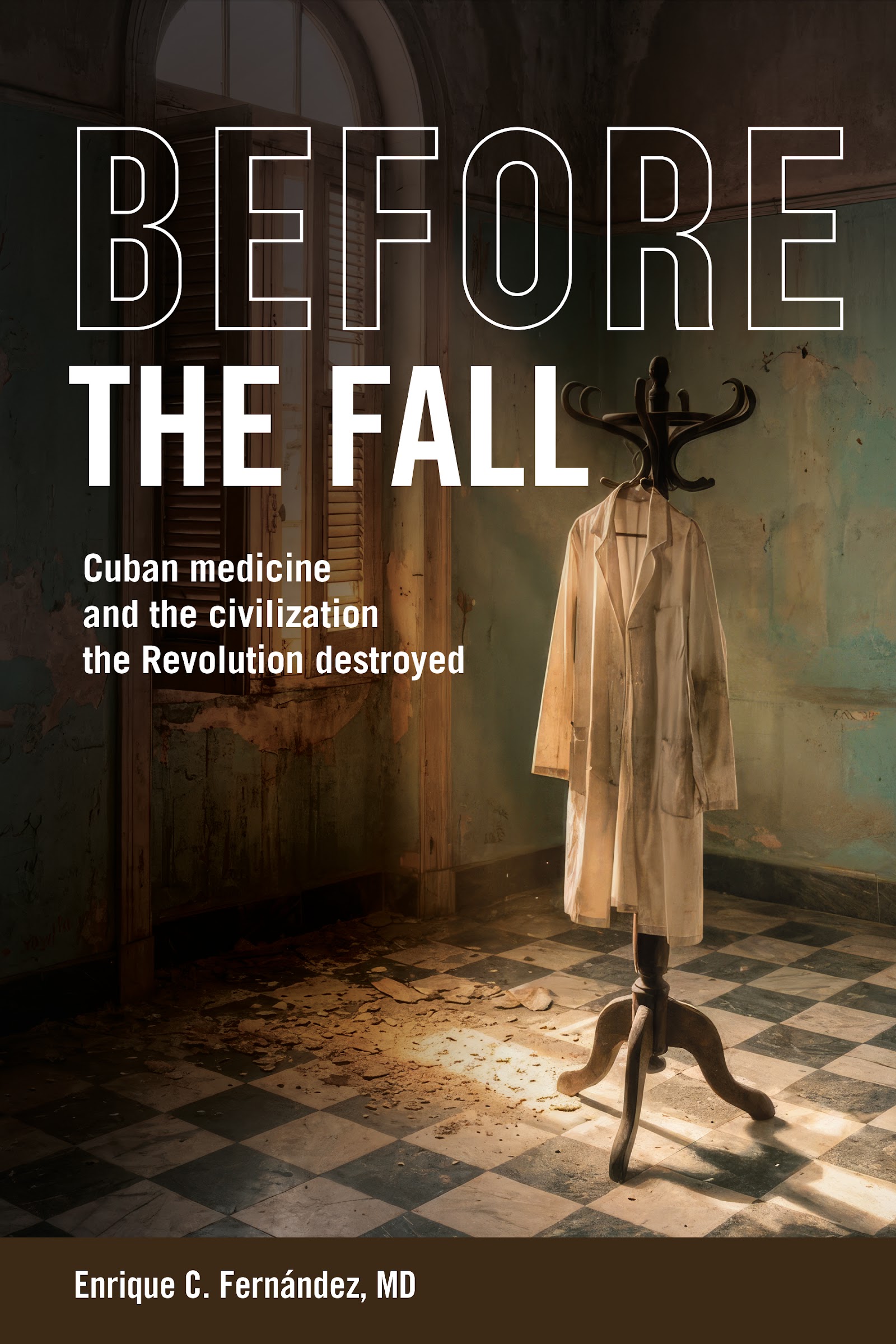
This is the subject of Before the Fall: Cuban Medicine and the Civilization the Revolution Destroyed, released December 3, 2026.